

Is Cholesterol The Villain We Think It Is?
By Dr. Robert Foster, DC
I’m sure that most people reading this have heard of cholesterol and have an idea of its role in heart disease. Cholesterol levels are something that every doctor checks when a patient has a yearly physical and bloodwork. After all, heart disease is currently the leading cause of death in the United States. Statins, the pharmaceutical treatment for high cholesterol, are second only to high blood pressure medications as the most commonly prescribed in this country. As chiropractors, however, we see firsthand how frequently patients on statins experience side effects. Statin drugs reduce CoQ10 levels and mitochondrial function, especially within skeletal muscle, leading to fatigue as well as muscle aches and weakness. As with most medicines, there is a time and a place where they are necessary. But this raises the question: Does a high cholesterol number always indicate the need for a statin? And has your doctor looked at the whole picture before prescribing one to you?
Regarding cholesterol, you may know there is “bad cholesterol” (LDL) and “good cholesterol” (HDL). But did you know that LDL and HDL, which are what we test for in bloodwork, are not actually cholesterols at all? They stand for Low-Density Lipoproteins and High-Density Lipoproteins, respectively. These LDL and HDL molecules transport cholesterol within our body; they are like “taxis” transporting “passengers” from the liver to various parts of the body where the cholesterol is needed. And cholesterol is needed! It is the precursor or building block to many hormones in our body, such as cortisol, vitamin D, and sex hormones like testosterone, estrogen, and progesterone. So, if you’re a male with low testosterone or a female going through menopause, sufficient cholesterol levels are essential. A few decades ago, the accepted level of total cholesterol listed on bloodwork results used to be higher and varied depending on the sex and age of the patient.
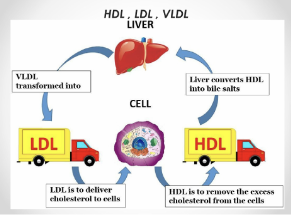
To simplify HDL vs. LDL: LDL transports cholesterol from the liver out to the cells and arteries within the body, whereas HDL transports these cholesterol passengers back to the liver, away from the arteries. Ideally, we don’t want too many of these cholesterol “passengers” to enter the arteries, where they can accumulate and block arteries, causing heart disease, which is why more LDL is typically bad. A big caveat here, though, is that to enter the arteries, there is a roadblock that has to do with the size of the individual cholesterol particles. As arteries have walls to keep toxins out, there are small gaps in these walls that allow cholesterol to enter. Think of a small opening or tunnel in this analogy. The smaller the cholesterol molecule, the easier it is to fit into this tunnel or get
inside the artery, where we don’t want it.
For this reason, our risk factor for heart disease depends not just on the quantity or number of the “bad” LDL, but also on how many of these LDLs are small vs. big, with smaller equating to higher risk. So, wouldn’t it make sense to test our blood for not just the amount of cholesterol and LDL, but also the size of these LDL particles? Well, this test does exist, but unfortunately, most primary care doctors do not order them.
Now, let’s say this cholesterol “particle-size test” comes back with high quantities of the “bad” small-sized LDL particles. Does this immediately mean you should go on a statin? Maybe, but while you may have more cholesterol particles getting into the arteries, we still don’t know how badly they are accumulating or causing “plaques” along with fats and calcium. However, again, there is an advanced test for this called a calcium score. This “score” correlates to the level of plaque, which hardens and narrows your blood vessels.
If these tests all come back with news of elevated risk for heart disease, then a statin may be in the discussion. But there are also non-pharmaceutical interventions that can be attempted first. For example, there are some natural supplements that can have the same effects as a statin and often may achieve the same outcome of reducing cholesterol. On top of this, lifestyle changes and assessing hormones that impact our need for cholesterol can help as well. While there is a little more to this, including genetics like familial hypercholesterolemia, it’s a fair summary of further steps that should be taken. If you would like to learn more about these natural approaches or have thorough testing done to examine your true risk for heart disease, you can schedule a functional medicine appointment where we can do a deep dive into this and more.